I automate software delivery from the commit to the alarm. Trained in systems integration, then nearly three years responsible for the availability and recoverability of production SQL Server databases — that teaches you to think in failure modes first.
Measure, don’t assume — and keep every change reversible.
Trained in systems integration, I now automate software delivery from the commit to the alarm. Nearly three years spent guaranteeing the availability and recoverability of production SQL Server databases taught me to think in failure modes first.
A complete AWS environment with Terraform, ECS Fargate, Lambda and CloudWatch, built and operated on my own responsibility. I use MyMifa every day myself — which is exactly why it has a CI pipeline, infrastructure as code and alarms around it: because it hurts when it breaks.
Certified STACKIT Cloud Engineer at Schwarz Digits. The way I work: measure instead of assume, and make every change reproducible and reversible.
Cloud Infrastructure
AWS (IAM, S3, Lambda, EventBridge, ECS, VPC, ALB) and STACKIT — built and operated on my own responsibility
CI/CD & Infrastructure as Code
GitHub Actions and Terraform used on my own project: six blocking checks per PR, AWS infrastructure fully described in code
Fullstack practice
Next.js, React, Node.js, TypeScript — three projects live on Vercel, Render and Netlify
Operations & Monitoring
CloudWatch alarms, Sentry, budget alerts — I want to hear about problems before anyone else reports them
Technical Skills
Tools & technologies I work with.
CI/CD & GitOps
Pipelines and declarative deployment from the repository
STACKIT University — STACKIT Product Fundamentals, DevOps Fundamentals, Terraform Fundamentals, Cloud Foundry Fundamentals, Deploying an Application with STACKIT Kubernetes Engine, Kubernetes Fundamentals, Docker Fundamentals, Linux Fundamentals (March 2026)
AI Fluency: Framework and Foundations — Anthropic, in partnership with University College Cork (2026)
Microsoft SQL Server Administration — KiawiTechIT Academy, over 600 hours (Oct 2022 — Jan 2023)
German language certificate level B1 — Anglo-German Institut, Stuttgart (2022); current level B2
Experience & Education
Where I’ve worked & learned.
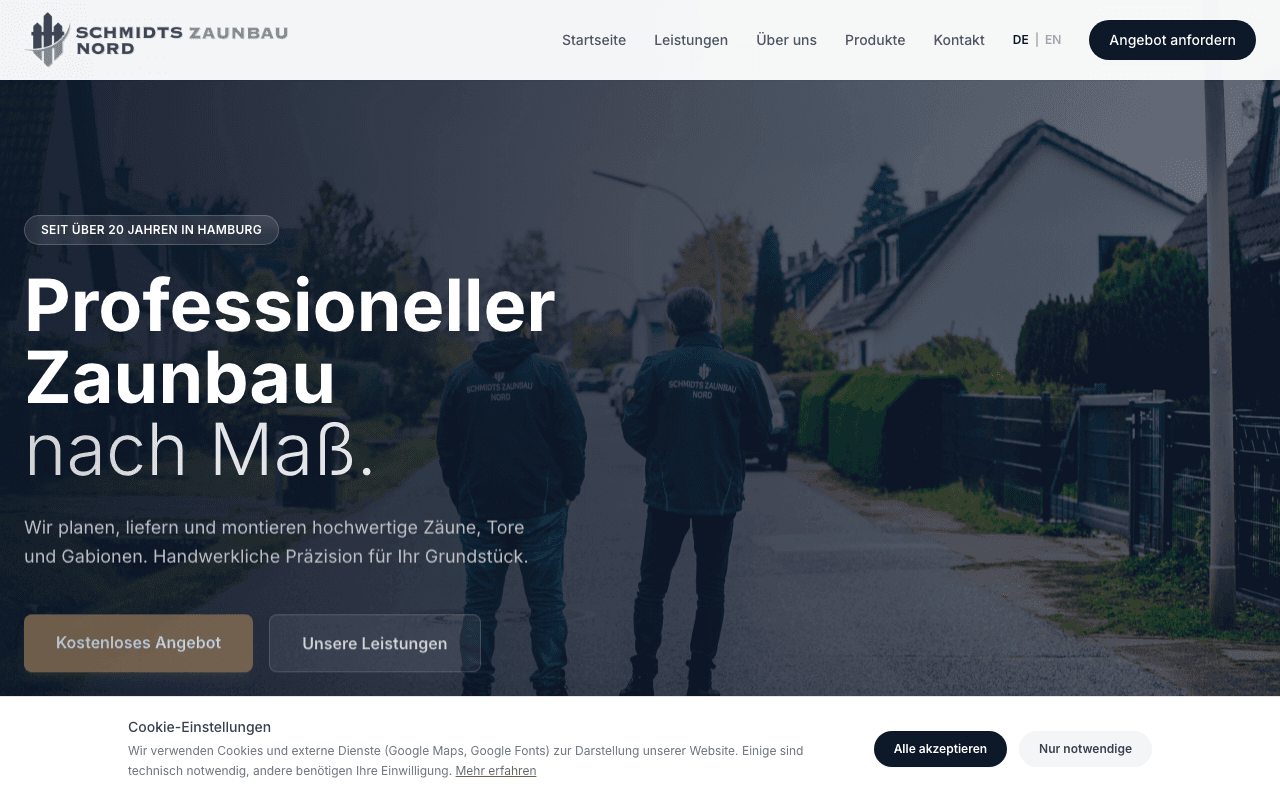
Website relaunch and deployment automation
Schmidszaunbau, freelance project, Hamburg
March 2026
Identified the genuinely served docroot among four duplicated directories of an undocumented legacy infrastructure, by matching Last-Modified HTTP headers against file mtimes on the server. Environment documented in a runbook.
Replaced manual FTP deployment with a Bash pipeline using rsync over SSH: dry-run mode, configuration through environment variables, SSH key handling.
Automated verification after every release through curl smoke tests: checks the live German and English content and the API endpoint's HTTP status, failing unambiguously on regression.
Replaced the external form service with a self-hosted PHP backend: input validation, SMTP header injection protection, honeypot against spam, send fallback and logging of failed attempts.
Consistent timestamped backups before every production change, keeping an immediate rollback possible.
Bashrsync over SSHPHPcurlSTRATO hosting
SQL Server Database Administrator
GDE Solution GmbH, freelance, Eberdingen
May 2023 — March 2026
Backup and recovery: automated strategies for full, differential and transaction log backups, regularly tested restore procedures verifying data consistency and RTO/RPO targets, high availability through AlwaysOn Availability Groups, Failover Cluster Instances and log shipping.
Security and access: accounts, roles and permissions managed on least-privilege principles, encryption at rest through TDE and in transit, compliance audits and detection of unauthorised access.
Performance tuning: analysis of system metrics (CPU, memory, disk I/O, locks and deadlocks), identification and optimisation of slow T-SQL queries through indexing, rewriting and statistics updates, automated preventive maintenance via index rebuilds and DBCC CHECKDB.
Installation and maintenance: provisioning and configuration of instances both on-premises and on cloud virtual machines, applying cumulative updates and service packs, version upgrades and migrations, capacity planning for growing data volumes.
Microsoft SQL ServerT-SQLAlwaysOn AGTDELog shipping
DevOps Engineer, industrial systems and IoT
High Tech Industry, Odessa, Ukraine
July 2021 — February 2022
Continuous delivery pipelines with GitLab CI and GitHub Actions, shipping code safely to local servers, IoT gateways and programmable logic controllers.
Automatic alerting on loss of connection to a network gateway or on signs of an industrial control system failing.
Infrastructure as code with Terraform for the servers, databases and networks holding industrial reports and energy consumption history.
Interface between development and the plant floor: automating software tests together with electrical engineers and PLC programmers, ahead of physical installation into the control cabinets.
GitLab CIGitHub ActionsTerraformIoT gatewaysPLC
Bachelor in Banking and Finance
University of Dschang, Cameroon
Awarded 2020
Fachinformatiker Systemintegration
Collège de la Salle, Douala, Cameroon
Awarded 2019
Projects
Five projects, I actually work on.
Three of them are live and clickable, two are open as repositories. No mockups — deployed and operated by me.
M
MyMifa
Job application tracker — and my DevOps workshop
Live
A tool I use to manage my own job search: applications, interview prep, automatic detection of recruiter replies. The app already worked. What came next is the interesting part — making its operation something I can actually prove: a pipeline, infrastructure as code, alarms.
Architecture — from commit to alarm
Swipe sideways to explore
CI — six blocking checks per pull request
Swipe sideways to explore
GitHub ActionsTerraformAWS LambdaEventBridgeCloudWatch+5 more
What I took away: don't trust a system until you've measured it. Every assumption — the cron, the migrations, the deployment — turned out to be wrong at some point.
A local three-node cluster carrying the same application twice: once as raw manifests, once as a Helm chart. That comparison is what makes the reason Helm exists visible. On top of it: Prometheus with alerting rules of my own, a Grafana dashboard provisioned from files, and ArgoCD reconciling the cluster against the repository instead of against the last command someone typed.
kind cluster — from the host down to the pod
Swipe sideways to explore
Declared state — deployment, configuration, probes
Swipe sideways to explore
One chart, two releases
Swipe sideways to explore
From a commit to a graph
Swipe sideways to explore
KuberneteskindHelmArgoCDGitOps+6 more
A cluster on a laptop costs nothing and forgives everything. That is exactly why I break it there and not somewhere else.
Client project — relaunch and deployment automation
Live
A fence-construction site in Hamburg, sitting on undocumented legacy infrastructure and updated by hand over FTP. The visible work was the relaunch. The real work was finding out which directory was actually being served.